
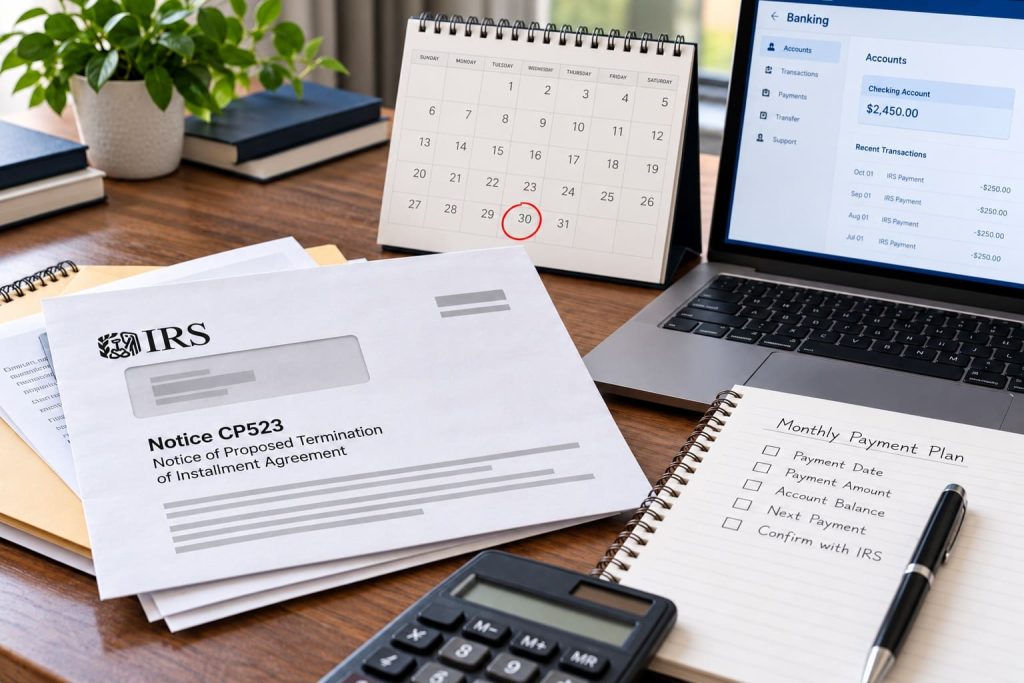
An IRS CP523 Notice can come as a surprise, especially if you thought your tax payment plan was under control. You may have missed a monthly payment, your bank may have rejected a withdrawal, or you may owe additional taxes from a recently filed return. You may not even recognize why the IRS is issuing the notice.
Whatever caused the problem, the notice deserves immediate attention.
An IRS CP523 Notice generally means the IRS intends to terminate your existing installment agreement because it considers the agreement to be in default. It also warns that the IRS may take collection action if you don’t resolve the issue.
That doesn’t necessarily mean your payment plan has already ended. Depending on the circumstances, you may still be able to correct the default, reinstate your agreement, or challenge the proposed termination.
The important question is what caused the default and whether you can resolve it before the IRS takes further action.
Quick Answer: What Should You Do After Receiving IRS Notice CP523?
Contact the IRS as soon as possible, and no later than 30 days from the date of the notice. Review why your installment agreement is in default, correct any missed payments or other compliance issues if possible, and confirm with the IRS what you need to do to keep the agreement in place.
If you disagree with the proposed termination, you generally have the right to request an appeal through the IRS Collection Appeals Program (CAP).
Your immediate priorities are to:
- Check the CP523 notice date and the reason for the default.
- Review your payment history and current IRS account information.
- Determine whether the problem can be corrected before termination.
- Call the IRS at the number listed on your CP523 notice.
- Ask whether your agreement can continue, must be reinstated, or needs to be revised.
- Challenge the IRS’s decision if you disagree with the proposed termination.
The IRS’s official CP523 instructions explain what you must do in response. Don’t assume that making a payment, submitting an online request, or calling the IRS automatically resolves the notice.

What Is an IRS CP523 Notice?
IRS Notice CP523 is a notice of proposed termination of an installment agreement and a notice of intent to levy.
An installment agreement lets you pay an outstanding federal tax liability over time under terms the IRS accepts. In exchange, you must comply with the agreement, including making required payments and meeting applicable tax obligations.
When the IRS determines that certain conditions haven’t been met, it may place the agreement in default.
There are three distinct stages to understand:
- Default: The IRS has identified a failure to comply with the installment agreement.
- Proposed termination: The IRS gives notice that it intends to end the agreement unless the problem is resolved or an appropriate appeal is pursued.
- Termination: The agreement has ended, subject to any applicable appeal rights and collection restrictions.
The distinction matters. A CP523 normally concerns a proposed termination, not proof that your agreement has already been terminated.
Under Internal Revenue Code § 6159, the IRS generally must provide advance notice explaining why it intends to terminate an installment agreement. A statutory exception exists when the IRS believes collection is in jeopardy.
Is CP523 the Same as an IRS Levy?
No.
CP523 warns of possible collection action, but it does not mean the IRS has already seized your bank funds or wages.
A levy is an enforcement action against property or property rights, such as funds in a bank account or wages.
The IRS generally faces statutory restrictions on levying for liabilities covered by an installment agreement while the agreement remains in effect and during certain appeal periods. Those restrictions have exceptions and do not necessarily protect tax liabilities outside the agreement.
CP523 also should not be confused with a separate final levy notice that provides Collection Due Process hearing rights.
What to Do Immediately After Receiving CP523
First, identify what went wrong. A taxpayer whose bank rejected one payment may need a different resolution than someone with another unpaid tax balance.
Step 1: Read the Notice Carefully
Find the notice date, the tax periods involved, the stated reason for default, any amount the IRS says must be paid, and the instructions for responding.
Check whether the notice refers to a missed installment or another issue.
If you have received several notices, don’t assume each one requires a separate payment. Ask the IRS to identify the amounts and tax periods covered by your agreement.
Step 2: Verify Your Payment History
Compare the IRS account information with your bank statements and payment confirmations.
If you use automatic direct debit, check whether the withdrawal occurred. A transaction you expected may have been rejected because of insufficient funds, an incorrect account number, or another banking issue.
If you paid electronically, keep the confirmation number and verify that the payment was credited to the appropriate tax period.
You can review available payment information through your IRS Online Account.
Step 3: Identify What Needs to Be Corrected
If you missed a payment and can afford to bring it current, review the notice instructions and arrange payment before the stated termination date.
If the problem involves a new tax liability, an incorrect payment posting, or financial information the IRS requested, a payment alone may not resolve the default.
The IRS needs to determine that the underlying problem has been addressed.
Step 4: Contact the IRS
Call the number printed on CP523.
Explain the situation and ask the representative to confirm:
- The precise reason for the default.
- The amount or action required to correct it.
- Whether your agreement is still in default status or has been terminated.
- Whether reinstatement or modification is available.
- Whether any additional tax periods must be addressed.
- Whether further documentation is required.
If you believe the IRS made an error, explain the discrepancy and have the supporting records available.
Step 5: Confirm the Outcome
This step is especially important when you’ve already made a payment.
The IRS specifically instructs taxpayers who have taken corrective action to contact it to ensure it records the action.
Don’t rely solely on a bank withdrawal, payment receipt, or an account screen that still displays your old agreement.
Confirm whether the IRS considers the default resolved and whether your future monthly payments should continue under the original terms.
Keep a record of the contact, including the date, the representative’s name or identification number if provided, and any instructions.
Why Did the IRS Send You CP523?
There isn’t one universal reason for an IRS payment plan termination notice.
The IRS identifies several grounds for proposing termination in Internal Revenue Manual 5.14.11.3.
You Missed a Monthly Installment
A payment that doesn’t arrive when required can place an agreement in default.
For example, you might believe the payment went through because you had arranged a direct debit. But if the bank rejected the withdrawal, the IRS may never have received the money.
The practical response is to verify what happened, correct the missed payment when possible, and confirm that the IRS has recognized the correction.
You Have a New Unpaid Tax Liability
An existing installment agreement doesn’t excuse you from paying taxes that become due later.
Suppose you’re making monthly payments toward an older income tax debt and then file another return showing additional tax you cannot pay.
The unpaid new liability may cause the existing agreement to default, even if you’ve continued making the original monthly payments.
The IRS may require payment of the new liability or consider changing the agreement to address the additional debt. The result depends on the account and the applicable installment-agreement requirements.
Your Payment Was Made but Wasn't Properly Credited
Sometimes the issue isn’t whether you sent money, but whether the IRS recorded it correctly.
A payment may require research because of an incorrect tax-period designation, processing delay, or other account discrepancy.
If your records show that you paid, present the payment date, amount, method, and confirmation information.
Before paying again, contact the IRS with your payment confirmation and ask it to trace the original payment. Don’t let the CP523 response deadline pass while the IRS looks into the issue.
You Didn't Provide Requested Financial Information
The IRS may request updated financial information when evaluating whether your agreement remains appropriate.
If you fail to provide the required information, the IRS may propose termination.
The relevant records may include income, living expenses, bank balances, assets, and liabilities.
The IRS may also take action when information supplied to obtain an agreement was inaccurate or incomplete, or when a taxpayer fails to pay a modified amount required under the agreement.
What About Unfiled Tax Returns?
You are generally expected to remain current with filing and payment obligations.
However, an important distinction appears in IRM 5.14.11.3: a delinquent-return indicator does not, by itself, automatically default an existing balance-due installment agreement.
Missing returns can nevertheless create serious compliance problems and affect an IRS decision about continuing or reinstating the arrangement.
If the IRS identifies unfiled returns, determine which returns are required and how they affect your overall account.
Can You Stop Your IRS Payment Plan from Being Terminated?
In many situations, you can address the proposed termination before the agreement ends.
First, determine whether you can correct the default under the existing arrangement or whether the IRS needs to evaluate a different payment plan.
Match the Reason for Default to the Appropriate Response
Your situation | Practical next step | What needs to be confirmed |
You missed a payment but can afford it | Make the required payment as directed and contact the IRS | Whether the payment cures the default and the agreement will continue |
The IRS says you missed a payment you already made | Provide payment records and request account research | Whether the payment has been correctly credited |
A direct debit was rejected | Determine why the withdrawal failed and correct the missed payment | Whether future bank withdrawals are properly scheduled |
You owe additional taxes | Review the new liability and ask about payment or modification options | Whether the IRS will require full payment or consider a revised agreement |
You cannot afford the original installment | Request review of your payment amount and financial circumstances | Whether you qualify for a revised arrangement or another collection alternative |
The IRS requested financial information | Provide the requested documents through the appropriate process | Whether the information satisfies the IRS’s requirements |
The IRS’s internal guidance says that an agreement still in default status, but not yet terminated, must be reinstated if the taxpayer remedies the default and no other grounds for default exist.
That does not mean every taxpayer can make one payment and assume the agreement is safe. The IRS must recognize the correction, and other outstanding issues may still need attention.
Hypothetical Example: A Missed Payment That Was Later Corrected
Assume a taxpayer has been making monthly payments under an IRS installment agreement. One scheduled payment fails because there was not enough money in the checking account.
The taxpayer later submits the missed payment electronically and receives confirmation.
Several days afterward, CP523 arrives.
After receiving CP523, the taxpayer calls the IRS with the payment confirmation and asks whether the payment was applied to the correct tax period. The taxpayer also checks whether another default exists and whether the original monthly payment schedule will continue.
Can You Reinstate or Change Your IRS Installment Agreement?
Yes, you may be able to reinstate or modify it, depending on why the agreement defaulted, its current status, your financial circumstances, and your compliance history.
Reinstating a Payment Plan Online
The IRS allows eligible individual taxpayers to use its Online Payment Agreement application to review or revise an agreement and, when available, reinstate a plan after default.
The tool may allow qualifying users to:
- Change their monthly payment amount.
- Change their payment due date.
- Update direct-debit banking information.
- Convert an eligible arrangement to direct debit.
- Reinstate an agreement after default.
Not every taxpayer or account can use the online option.
If your account does not permit the necessary change, follow the instructions on CP523 and contact the IRS.
Business tax accounts and cases assigned to a revenue officer can require different handling.
What Does IRS Payment Plan Reinstatement Cost?
The IRS currently lists the following standard fees for revising or reinstating an existing installment agreement:
Method | Published fee |
Eligible online reinstatement or revision | $6 |
Reinstatement or revision by telephone, mail, or in person | $89 |
Qualifying low-income manual reinstatement or revision | $43, potentially reimbursable |
Certain qualifying low-income direct-debit agreement changes | $0 |
See the IRS’s current payment-plan fees before making a request, because fee schedules can change.
What If the IRS Requires a Financial Statement?
When the IRS cannot approve the requested arrangement under its standard criteria, it may require a Collection Information Statement and supporting records.
Depending on the taxpayer and the collection situation, the IRS may request Form 433-A, Form 433-F, Form 433-B, or Form 433-H.
These forms help the IRS evaluate income, allowable expenses, assets, and ability to pay.
Not every reinstatement requires a financial statement.
For a detailed explanation, see our guide to IRS Forms 433-A, 433-F, and 433-B.
If you’re considering a different installment arrangement, our IRS Form 9465 guide explains how payment-plan requests work and when the online application may be preferable.
What Is the IRS CP523 Deadline?
The initial response period is one of the most important parts of the notice.
The IRS instructs recipients to contact it as soon as possible, but no later than 30 days from the date of the CP523.
The notice date is not necessarily the day it arrives in your mailbox.
Under the ordinary proposed-termination process, the IRS provides a period to correct the default or exercise applicable appeal rights before termination.
What If You Miss the Initial 30-Day Period?
If the agreement has actually been terminated, a separate appeal period may still apply.
IRS Publication 1660 explains that the right to appeal generally continues for an additional 30 days after termination.
But this does not give you an unrestricted extension to correct the original default. By then, the agreement may have already ended, and your options for resolving the account may differ.
Contact the IRS immediately to verify the account status and any remaining rights.
Does the IRS Give You 90 Days After CP523?
Not as a general taxpayer response deadline.
IRM 5.14.11 describes an internal levy-restriction and processing period associated with CP523 that incorporates the proposed-termination stage, post-termination protections, and mailing allowances.
That internal timeframe should not be interpreted as permission to wait 90 days before responding.
For practical purposes, follow the response deadline stated in the notice and address the issue as soon as possible.
How to Appeal an IRS CP523 Termination
If you disagree with the proposed termination and cannot resolve the disagreement with the IRS, you generally can request review through the Collection Appeals Program (CAP).
CAP allows the IRS Independent Office of Appeals to review certain collection decisions, including proposed or actual installment-agreement terminations.
When Can You Request a CAP Appeal?
The usual appeal opportunities are:
- Within 30 days from the date of the proposed-termination notice.
- For an additional 30 days after the agreement is actually terminated, if an appeal is otherwise available.
A taxpayer who already appealed the proposed termination generally cannot appeal the same decision again merely because the termination later takes effect.
The relevant IRS guidance is Publication 1660, Collection Appeal Rights.
How Do You Request an Appeal?
Start by contacting the IRS office or employee identified on your notice and explaining why you disagree.
State the collection action you’re disputing and the resolution you’re requesting.
Form 9423, Collection Appeal Request, is used for CAP appeals.
However, Publication 1660 distinguishes between appeals you may request by telephone and those that require a written submission. If a revenue officer proposes terminating your payment plan, you must appeal in writing, preferably using Form 9423.
A managerial conference is recommended but not generally mandatory before an installment-agreement termination appeal.
Follow the appeal instructions provided by the IRS office handling your case. If a written appeal is required and you send it by mail, your request must be postmarked within the applicable appeal period.
Does Appealing CP523 Stop an IRS Levy?
Internal Revenue Code § 6331(k) generally restricts levies for liabilities covered by an installment agreement during specified periods, including while the agreement is in effect, for 30 days following termination, and during a timely termination appeal.
Exceptions exist, including certain jeopardy situations. These protections should not be assumed to cover unrelated liabilities or every possible collection action.
A CAP appeal does not eliminate the tax debt or guarantee reinstatement.
CAP Appeals vs. Collection Due Process Hearings
CAP and Collection Due Process (CDP) are different procedures.
CAP is available for proposed or actual installment-agreement termination. It does not ordinarily allow you to contest the underlying amount of tax owed, and the CAP determination generally does not provide judicial review.
CDP rights arise from separately qualifying lien or levy notices and follow different requirements.
Receiving CP523 alone does not mean you should automatically submit Form 12153, the form normally used for CDP hearing requests.
If you have received other IRS collection notices, those notices may carry separate appeal rights and deadlines.
What Happens If You Ignore IRS Notice CP523?
If the default remains unresolved, the IRS may terminate the installment agreement.
Once the agreement ends and applicable restrictions no longer prevent enforcement, the IRS may resume collection activity for the unpaid liability.
Depending on the account and the notices already issued, these can include:
Wage Levies and Bank Levies
The IRS may seek payment from wages or funds held in financial accounts, subject to applicable notice requirements, statutory restrictions, and exemptions.
CP523 itself should not be treated as evidence that such a levy has already occurred.
A Notice of Federal Tax Lien
Depending on your tax situation, the IRS may file a Notice of Federal Tax Lien. CP523 alone does not trigger that filing.
A federal tax lien and a Notice of Federal Tax Lien are not the same thing. The statutory lien generally arises after assessment, demand for payment, and failure to pay, while the recorded notice alerts other creditors to the government’s claim.
If a lien notice has been filed, learn how IRS lien withdrawal and release differ.
Additional Interest and Penalties
An installment agreement does not stop interest and all applicable penalties from accruing.
If a previously reduced failure-to-pay penalty rate applied because an eligible agreement was in effect, termination may affect that rate.
The financial consequences depend on the type of liability and the account history.
Ignoring CP523 therefore creates risks beyond losing the convenience of monthly payments.
What If You Can No Longer Afford Your IRS Payment Plan?
Sometimes CP523 reveals a more fundamental problem: the payment amount was manageable when the agreement began, but your finances have changed.
Perhaps you lost income, had to pay more for essential living expenses, or took on additional debt.
If your current payment is no longer affordable, repeatedly missing installments is unlikely to provide a lasting solution.
Request a Lower Monthly Payment
Ask the IRS whether it can modify your agreement.
The IRS may consider your current income, allowable living expenses, assets, and the time remaining to collect the liability.
You may need to submit financial information.
A lower monthly payment is not guaranteed simply because you request it.
Consider Currently Not Collectible Status
If you cannot pay the tax without sacrificing necessary living expenses, the IRS may consider placing your account in CNC (Currently Not Collectible) status.
If the IRS approves CNC status, it generally pauses most collection efforts because you cannot afford to pay. You still owe the tax, and interest and penalties may continue. The IRS can also apply tax refunds toward your debt or file a Notice of Federal Tax Lien. Collection may resume if your finances improve.
See our guide to Currently Not Collectible status and the Taxpayer Advocate Service’s CNC explanation.
Should You Consider an Offer in Compromise?
An Offer in Compromise may be appropriate in certain cases where the IRS determines that accepting less than the full liability is justified under its rules.
It is not an automatic alternative to a defaulted installment agreement, and submitting or discussing an offer does not by itself resolve your CP523 notice.
To qualify for an Offer in Compromise, you generally must have filed all required tax returns, made any required estimated tax payments, and not be in an open bankruptcy case. Employers must also have made required federal tax deposits for the current and previous two quarters. The IRS reviews your income, expenses, and assets when evaluating an offer.
You still need to address the immediate CP523 issue while you consider longer-term options.
When Should You Seek Professional Tax-Resolution Assistance?
Some CP523 problems are relatively straightforward. A taxpayer may be able to correct a missed payment and confirm reinstatement directly with the IRS.
Other situations require more careful analysis.
Professional assistance may be especially useful when:
- The IRS is proposing termination for a reason you dispute.
- Multiple tax years or different types of tax liabilities are involved.
- You cannot afford the existing monthly payment.
- The IRS has already denied or failed to process a reinstatement request.
- You have received additional levy or lien notices.
- Your case is assigned to a revenue officer.
- An appeal deadline is approaching.
- Your collection history includes older liabilities with potentially important collection-statute issues.
Representation aims to identify the real issue, evaluate your IRS options, and help you communicate or negotiate based on accurate account and financial information.
Help With an IRS CP523 Notice
Long Island Tax Resolution Services assists taxpayers with federal tax collection problems, including installment agreements and other tax-resolution options.
If you received a CP523 and aren’t sure whether you can continue, reinstate, or change your payment plan, we can review your notice and account circumstances to help you choose the right next step.
Contact Long Island Tax Resolution Services to discuss your situation.
Don’t delay contacting the IRS or missing an appeal deadline while waiting for a consultation.
IRS CP523 Notice: Frequently Asked Questions
I Already Paid the Missed Installment. Can I Ignore CP523? ▼
No. The IRS specifically instructs taxpayers who have taken corrective action to contact it and verify that it recorded the action.
Confirm the payment was properly credited and the default is resolved.
Do I Have to Pay My Entire IRS Tax Balance to Stop Termination? ▼
Not necessarily.
What you need to do depends on why your agreement defaulted. Correcting a missed installment may be different from addressing a new unpaid tax liability.
Contact the IRS to determine the amount and action needed for your particular agreement.
Can I Reinstate an IRS Payment Plan More Than Once? ▼
Yes, reinstatement may still be possible after a previous default. The IRS considers why the agreement failed and whether you've met your tax obligations. Under IRS procedures, an agreement meeting streamlined criteria may be reinstated without a new financial review if you haven't defaulted on another installment agreement in the 12 months before the current default. Other cases may require updated financial information.
Why Did I Receive More Than One CP523 Notice? ▼
A taxpayer may receive CP523 correspondence relating to multiple tax periods.
Review the tax periods shown and ask the IRS to confirm whether the notices relate to the same agreement and what total amount is required to address the default.
Do not assume the same corrective amount must be paid separately for every notice.
What If I Received CP523 but My Online Account Still Shows a Payment Plan? ▼
The online information alone may not establish whether the IRS has removed a default condition or prevented termination.
Review your account details and call the number on the notice to confirm your current status.
Can the IRS Terminate My Agreement If I Keep Making Monthly Payments but Owe New Taxes? ▼
Yes. Failure to pay another tax liability when due is one of the statutory grounds that can support modification or termination of an installment agreement.
The IRS must apply the relevant notice requirements and procedural protections, subject to applicable exceptions.
Does CP523 Apply to New York State Tax Payment Plans? ▼
No. CP523 is a federal IRS notice.
It applies to IRS installment agreements nationwide, including agreements held by New York residents.
A separate New York State tax payment arrangement is governed by New York procedures, not the federal CP523 termination process.
The Most Important Step After Receiving CP523
Start by identifying why your payment plan defaulted.
If you can correct the problem, do so promptly and confirm that the IRS recognizes the correction. If your circumstances have changed, find out whether you can get a revised arrangement. If you disagree with the proposed termination, preserve your appeal rights.
CP523 is a serious collection warning, but it also gives you a chance to address the problem before the IRS takes further action.